Showing posts with label Acid-Base Unit. Show all posts

Tuesday, February 9, 2016

Finding the Mass of the Unknown Acid Lab

Today we finished writing our note card for the unknown acid lab! My partner and I were able to finish a day early because we used our standard from the last lab. Using our data, we did the math to find the molar mass of the substance, which between the two trials averaged about 177 g. I really enjoyed these labs due to the competition to get the best percent error. We were really focused on getting the exact amount of NaOH used. Below is our calculations for the lab and our results. We got around a 1.7 percent error!
Explanation of Lab

Monday, February 8, 2016

First day of Unknown Acid lab

Today we began our Unknown Acid lab! In order to complete this lab, we completed a titration of an unknown substance to find its molar mass. To start, we measured the amount of the acid and dissolved it in 100 mL of water and added 2-3 drop of phem. (an indicator). In order to get it to dissolve, we had to heat the solution on a hot plate, as well as add a stir bar to better mix the substance because it was partially soluable. Once the solution was completely dissolved, we let it cool then titrated the substance with NaOH until the substance turned pink. We took the measurement of the amount of NaOH used to titrate the solution and the amount of unknown acid we used to dissolve into the mixture. We will use this data tomorrow to calculate the molar mass of the unknown acid.
Reminder on how to titrate


Thursday, February 4, 2016

2nd day of Titration lab

Today we got to run our experiment! We had to move pretty fast because we had to get four trials done total (2 KHP, 2 Vinegar) in one class period. Below are our steps we followed for the day:
  1. Put on googles
  2. Drain burette
  3. Fill with small amount of NaOH and coat the sides of burette
  4. Dump excess NaOH into waste beaker
  5. Fill burette to 0 mL
  6. Measure .4-.6 grams of KHP and record mass
  7. Dump KHP into E. Flask and fill with 100 mL of water and ensure all KHP makes it into the flask
  8. Mix the solution until all the KHP dissolves
  9. Add 2-3 drops of phem.
  10. Tritate solution until it turns light pink. Record the mass of NaOH used
  11. Dump out contents of E. Flask 
  12. Fill flask with 10 mL of vinegar
  13. Add 100 mL of water and 2-3 drops of phem. 
  14. Titrate until pink and Record.
  15. Repeat
We also did our calculations today and explanation on how to do this can be found below.
Unknown Acid Lab video
How to Calculate Molarity in lab

Wednesday, February 3, 2016

First day of Titration: Getting used to the techniques

Today my partner wasn't here, so I did the practice lab with Ben. We learned how to do the steps for the lab so we would be ready for tomorrow. We went really slow at first because we were nervous, but then Mrs. Frankenberg came by and just poured the NaOH into our Erlenmeyer flask and it turned dark pink. I feel like we are ready tomorrow because we did two trials and we got it on the second try. Hopefully we are as ready as I think we are because this lab our grade is based on our percent error.


Monday, February 1, 2016

Overview of the Quiz

I felt okay about the quiz this week. I studied all weekend, especially on Sunday. During the quiz, I felt good about it until I started to go back and check my answers. I totally blanks on what was hydroponic and what was hydroxide and I started to panic. I think this is a great example of my exhausting that I felt during the quiz. After reviewing what answers I missed, I am very frustrated because they were all stupid mistakes. On one I got the right answer but picked the wrong answer on the test. Oh well... I just hope I don't make these stupid mistakes on the test.

Wednesday, January 27, 2016

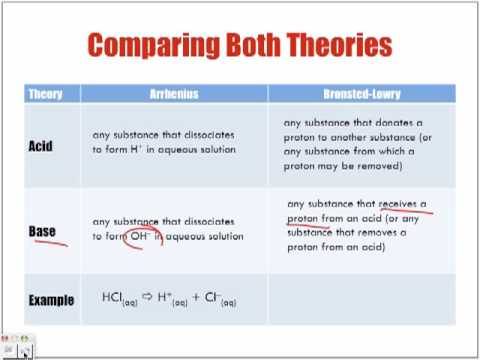
Acids and Bases: Arrhenius vs Bronsted-Lowey

Today we learned the difference between acids and bases; everything from the physical characteristics to their chemical makeup. We also learned the difference between Arrhenius and Bronsted-Lowery bases and acids. Below is a quick overview of what we learned:

Physical Properties
  • Acids- taste sour, feel sticky, show red or pink on litmus paper
  • Bases- taste bitter, feel slippery, show blue on litmus paper
Arrhenius Acids and Bases
http://img.youtube.com/vi/ph5lqm5fi8s/0.jpg
  • Acids- produce hydrogen ions in solution (H+) [HCL--> H+ + Cl-]
  • Bases- produce hydroxide ions in solution (OH-) [NaOH--> Na+ + OH-]
  • Amphitheater substance- can be an acid or a base  [water]
Bronsted-Lowery Acids and Bases
  • Acids- donate a proton (H+)
  • Bases- accept a proton (H+)
  • Conjugate acid- substance formed when a proton is added to a base
  • Conjugate base- remaining substance when a proton is lost from an acid
******* Acids produce conjugate bases, Bases produce conjugate acids********
Acid Strength
  • List of Strong Acids
    • Perchloric acid (HClO4)
    • Chloric acid (HClO3)
    • Hydrochloric acid (HCl)
    • Hydrobromic acid (HBr)
    • Hydroiodic acid (HI)
    • Nitric acid (HNO3)
    • Sulfuric acid (H2SO4) 
If the oxygen outnumbers the hydrogen by two or more, it is considered a strong acid.

For more information or practice use the links below:
Detailed Explanation with Examples
Video explanation
Shorter video
Quiz Yourself