Showing posts with label Energy. Show all posts

Monday, April 18, 2016

Heat Capacity of a Metal Lab

Today we got to complete the metal lab! Because of time restraints, we could not do both copper and lead so we had to pick which one we wanted to try. Half of the class did copper and the other half did lead. My partner and I choose to do copper. During the experiment, we used a form of calorimetry to determine the specific heat of copper. By measuring the increase in temperature of the water in which we put the copper in, we calculated the specific heat of the metal. We set the energy gained to the negative energy lost to find the answer. The steps we followed today:
  1. Places 100.mL of room temp. distilled water into a Styrofoam cup and recorded temp.
  2. Find the mass of the test tube
  3. Place metal in test tube about 1/3 of the way
  4. Find the mass of the test tube with metal
  5. Heat the metal up in a water bath to boiling. Let boil for 5 minutes then record the temperature of the water (the metal should be the same temp.)
  6. Pour the metal into the water with the Styrofoam cup. Place probe in cup and stir 
  7. Record the highest temperature reached by the water
Our Data:
  • mass of test tube- 15.9355
  • mass of test tube and metal- 54.9484
  • initial temperature of metal- 100.1 oC
  • initial temperature of H20- 23.4 oC
  • final temperature of metal and H20- 27.5 oC
 Using this data we were able to find the specif heat of copper!


Overview or explanation of lab
How to calculate specific heat

Friday, April 15, 2016

First Lecture

http://1048believe.com/wp-admin/js/specific-heat-capacity-formula-physics-i0.jpg

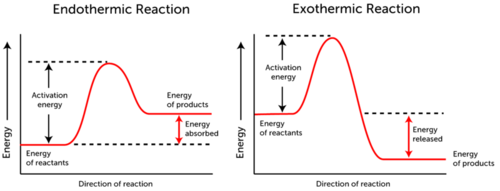
We learned about heat as a form of energy change. Heat occurs when bonds are formed, not when bonds are broken in chemical reactions. Exothermic- when energy leaves a system. Endothermic- when energy enters a system. Endothermic vs Exothermic
                                                        
Measuring Energy Changes

https://dr282zn36sxxg.cloudfront.net/datastreams/f-d%3Adf0a2687d885c997ec852a60b09181c51b0a234ada913
6e0288d4e8c%2BIMAGE_THUMB_POSTCARD%2BIMAGE_THUMB_POSTCARD.1
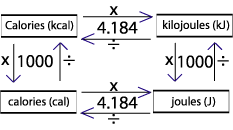
Measuring Energy Changes: converting Calories to calories and reverese

http://www.sartep.com/chem/images/calorieconvert.gif
 

Types of Energy
  • Kinetic Energy- energy of motion
  • Radiant Energy- energy from the sun or solar energy
  • Thermal Energy- energy associated with the random motion of atoms and molecules 
  • Chemical Energy- energy stored within the structural units of chemical substances
  • Potential Energy- energy stored or energy of position